

How AI Agents Are Transforming Customer Service in 2026

The playbook for digital customer support has officially flipped. For years, contact centers operated under an architecture of scarcity: limited human hours, backlogged ticketing queues, and rigid, scripted chatbots that could only direct users to an FAQ link.
In 2026, we are living in the era of abundance.
According to global data compiled by McKinsey and Zendesk, the mass deployment of generative AI has enabled organizations to achieve a 30% to 45% reduction in total operational service costs while driving net customer satisfaction (CSAT) scores up by 20%.
The primary catalyst behind this shift is the evolution from passive automation to active AI agents for customer service. Modern service leaders are no longer building tools that merely deflect conversations; they are deploying autonomous digital teammates that possess the authority to execute real business outcomes.
Moving Beyond Legacy Chatbots: The Architecture of Resolution
To understand why traditional support systems are failing, look no further than the foundational metrics used to score them. Legacy software prioritized the "Containment Rate" (tracking whether a customer stayed inside a chat window, regardless of whether their problem actually got solved).
The modern operational standard is anchored on the Goal Completion Rate (GCR). GCR measures the exact percentage of customer interactions where an autonomous system successfully executed an end-to-end task via secure API infrastructure.
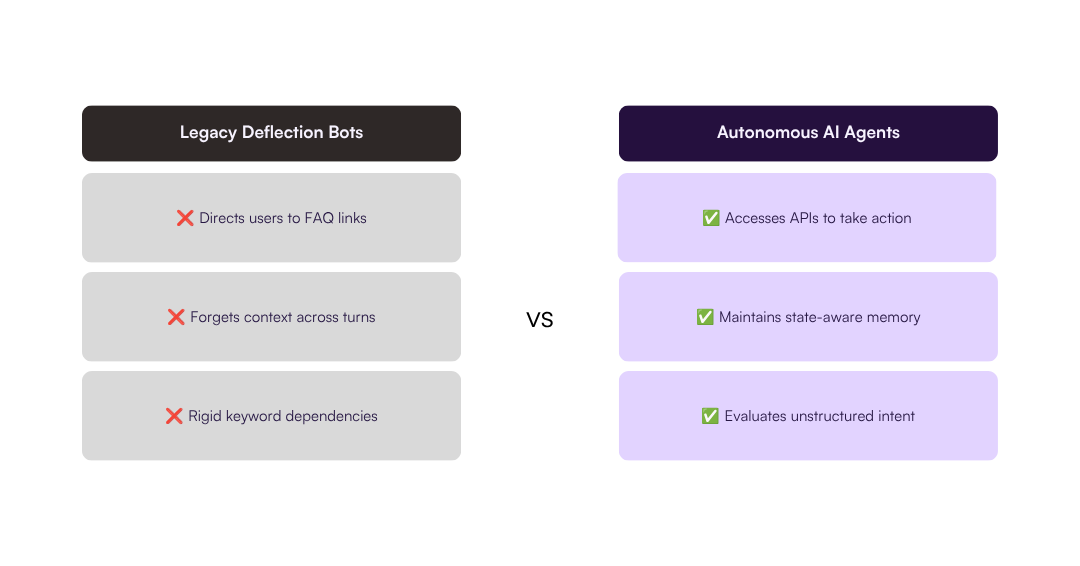
A true AI agent operates with active autonomy. It utilizes an intelligent Generative AI core to parse unstructured human dialogue, recall cross-session context, interact with localized databases, and modify backend systems without manual employee intervention.
4 Strategic Layers of Modern Support Automation
Production data across thousands of successful implementations demonstrates that a resilient customer service platform runs on four interconnected operational layers:
Layer 1: Real-Time Intent and Sentiment Triage
The millisecond an inquiry arrives (whether via your website, email, or the WhatsApp Business API) the AI analyzes the user's intent, immediate sentiment velocity, language pattern, and structural urgency. The message is instantly categorized and routed to the optimal track before a human ever views a dashboard.
Layer 2: Fully Autonomous Agent Resolution
For predictable, transaction-heavy inquiries (such as changing a shipping address, updating a billing cycle, or initiating a product return), the AI agent takes full outcome authority. It reads your core software applications, safely executes the database modification, logs the audit sequence in your CRM, and communicates the resolution to the customer in under two minutes.
Layer 3: Co-Pilot Agent Assistance for Human Teams
When an interaction flags an escalation trigger (such as an emotionally complex complaint or a premium, high-value client relationship), the AI transitions the thread to your live staff smoothly.
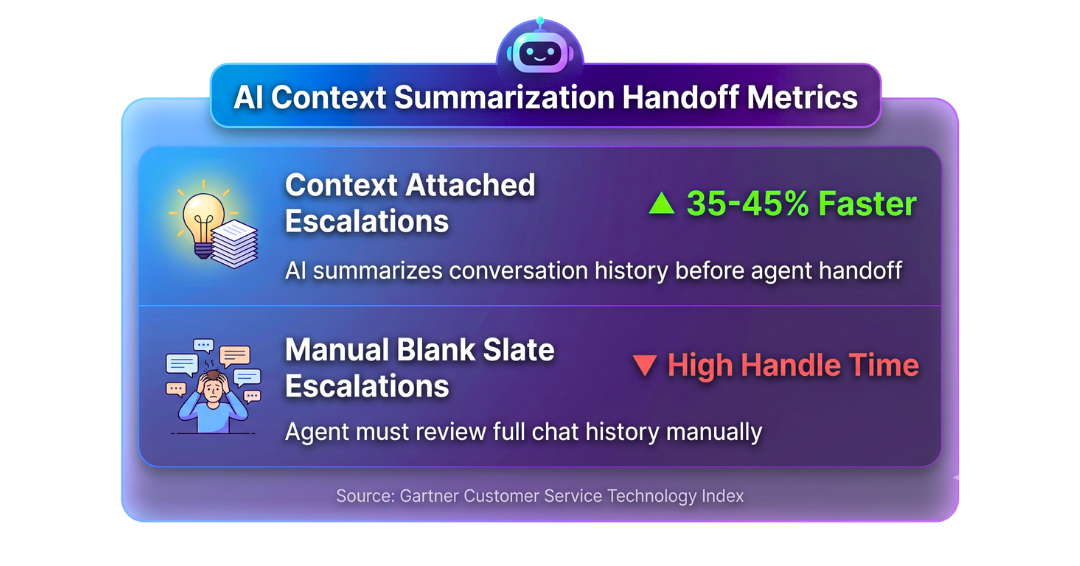
Data from Gartner indicates that human customer support representatives resolve issues 35% to 45% faster when escalations include full context attachments. The AiChat platform compiles an instantaneous conversational summary, identifies previous purchase history, flags the customer's historical friction points, and pre-drafts a tailored reply for your live representative to review and execute with a single click.
Layer 4: Continuous Operational Learning
Every finalized conversation is automatically vector-mapped to serve as structured training information. The underlying engine continuously monitors which workflows deliver permanent solutions, which technical responses preserve positive sentiment, and where the existing corporate documentation possesses clear gaps, systematically pushing your resolution durability higher over time.
The True ROI: Measuring What Matters
Relying on legacy metrics like Average Handle Time (AHT) makes little sense when system capacity is functionally infinite. Leading organizations have shifted their scorecards to track Resolution Durability.
Resolution Durability measures the exact "shelf-life" of a provided solution. It tracks whether a customer inquiry stayed completely resolved for at least 7 to 10 days without forcing the user to re-contact the support department regarding the same root issue.
$$Resolution\ Durability = \left(\frac{Total\ Resolved - Recursive\ Contacts}{Total\ Resolved}\right) \times 100$$
When your AI infrastructure prioritizes permanent, API-verified fixes over quick text deflections, your client retention metrics climb organically, turning your support operation from an isolated cost center into a direct driver of brand loyalty.
Scaling Support Without Engineering Overhead
Once your leadership team recognizes the competitive necessity of deploying AI agents for customer service, the defining problem becomes execution: Do you build a custom infrastructure from scratch, or do you integrate an established platform?
Choosing a ground-up agency project requires significant capital expenditure (often scaling from $20,000 to $80,000+ upfront). Furthermore, it saddles your business with unpredictable cloud infrastructure bills, out-of-pocket token usage expenses, and the technical responsibility of patching broken APIs every time a backend tool modifies its code framework.
Why Growing Brands Deploy on AiChat
The AiChat Platform Stack removes the financial risk and technical complexity of custom software builds. Instead of paying expensive external development teams to invent baseline messaging infrastructure and dashboard interfaces, your brand activates a secure, enterprise-grade engine built to scale instantly.
- Omnichannel Fluidity: Manage website text threads, social media direct messages, and the WhatsApp Business API inside a single, unified workspace.
- Regional Linguistic Optimization: Our native generative core interprets localized language patterns, slang, and code-switching (Singlish, Manglish, and Bahasa) flawlessly out of the box without hidden data-cleansing fees.
- Security Beyond the Model: Protect sensitive consumer data with built-in PII data-masking mechanisms, strict user access controls, and detailed audit logging designed to pass rigorous IT compliance reviews seamlessly.
- Predictable Subscription Modeling: Eliminate hidden maintenance fees. All software updates, vector data hosting, server management, and technical platform iterations are completely bundled into a single, transparent monthly subscription.
Stop allowing routine support queues to backlog your internal operations, exhaust your human staff, and compromise your client retention metrics. Bring active outcome authority to your customer service channels.
[Stop Building Support From Scratch — Book Your Live AiChat Platform Demo Now]
Frequently Asked Questions

.svg)
Answer
An enterprise-grade platform never leaves a frustrated user stuck inside an automated chat loop. The moment an AI agent identifies a drop in a customer's sentiment score or captures explicit urgency indicators, it triggers an immediate escalation protocol. The conversation is instantly routed to a live human manager, transferring a complete text summary of the interaction history so the user experiences zero friction.

Answer
Unlike custom agency projects that require months of technical architecture design, deploying through an established platform like AiChat simply requires uploading your existing business guidelines, standard operating procedures (SOPs), or pricing tables. The system securely processes these files to establish its baseline data pool, enabling you to launch a custom-tailored agent in 2 to 6 weeks.
Answer
To protect data integrity, AiChat utilizes a secure design framework that isolates the AI's data boundaries. The system can only pull answers from the verified internal documentation you choose to upload, operating within strict deterministic guardrails. If a customer asks a question outside of your approved business files, the agent is restricted from guessing; instead, it routes the conversation directly to your human support team.


