

Ramadan Consumer Trends in Southeast Asia 2026
.png)
Executive Summary: Ramadan is the most commercially significant period of the year for businesses in Southeast Asia, but most brands still plan their campaigns based on assumptions rather than data. This article covers the consumer behaviour patterns that repeat every Ramadan - from when people shop to what drives them to buy - so your marketing is built on insight, not guesswork.
Every year, millions of consumers across Southeast Asia change their routines, spending patterns, and communication habits for a full month. For businesses, this creates one of the most concentrated commercial opportunities in the regional calendar.
But Ramadan is not simply a sales period you can approach with a generic discount campaign and a few scheduled posts. The consumer behaviour during this month is specific, predictable, and well-documented - and the brands that understand it outperform those that do not.
This article covers the key consumer trends that repeat every Ramadan across Southeast Asia, and what they mean practically for any business trying to reach and serve Muslim consumers during this period. If you are still building your campaign strategy, read our guide on how to drive sales and stay responsive during Ramadan first.
Trend 1: Shopping Starts Earlier Than Most Brands Expect
One of the most consistent findings in Ramadan retail data is that consumers begin their purchase journeys significantly before the month starts.
Research from Criteo tracking retail sales across Southeast Asia found that purchases made in the final two weeks of Ramadan involved an average of 19 days between a shopper's first product visit and completed purchase with some journeys extending beyond 50 days. This means consumers who buy at Eid often started researching before Ramadan even began.
At the same time, conversion activity concentrates in the final stretch. Discovery happens early. Decisions happen late. This two-phase pattern has important implications for how brands should structure their campaigns: awareness and consideration work should begin well before Ramadan, while conversion-focused messaging belongs in the final two weeks.
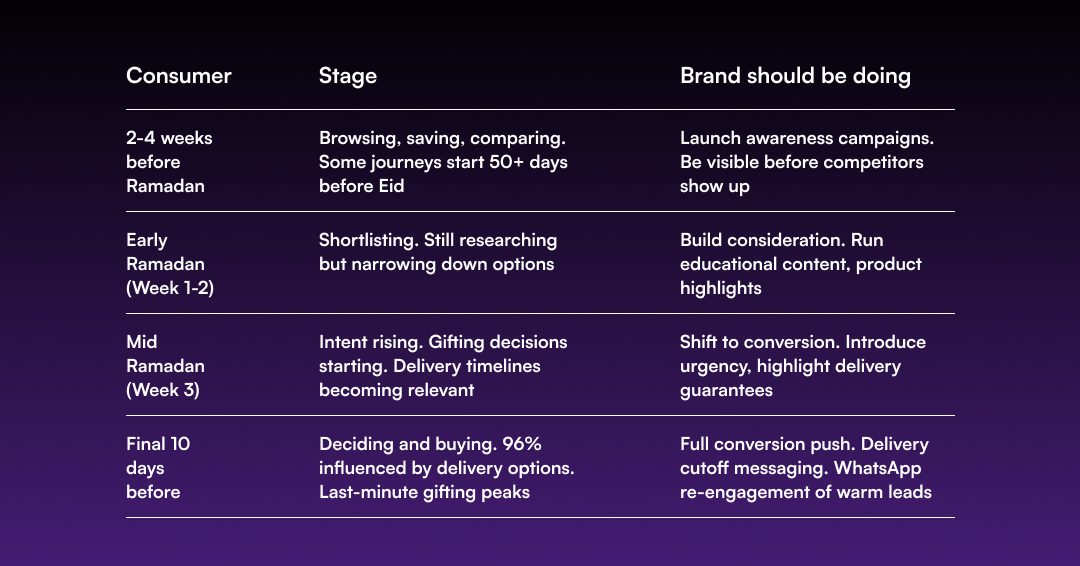
The brands that wait for Ramadan to start before launching their campaigns have already missed the consideration window for a significant portion of their potential buyers.
Trend 2: Daily Shopping Behaviour Follows the Fast
During Ramadan, consumer activity does not follow the normal retail clock. It follows the fast.
Daytime hours see a natural dip in activity as fasting consumers avoid food-related browsing and reduce discretionary spending impulses. The real commercial window opens after Iftar, the evening meal that breaks the fast, typically around 7pm to 8pm depending on the time of year.
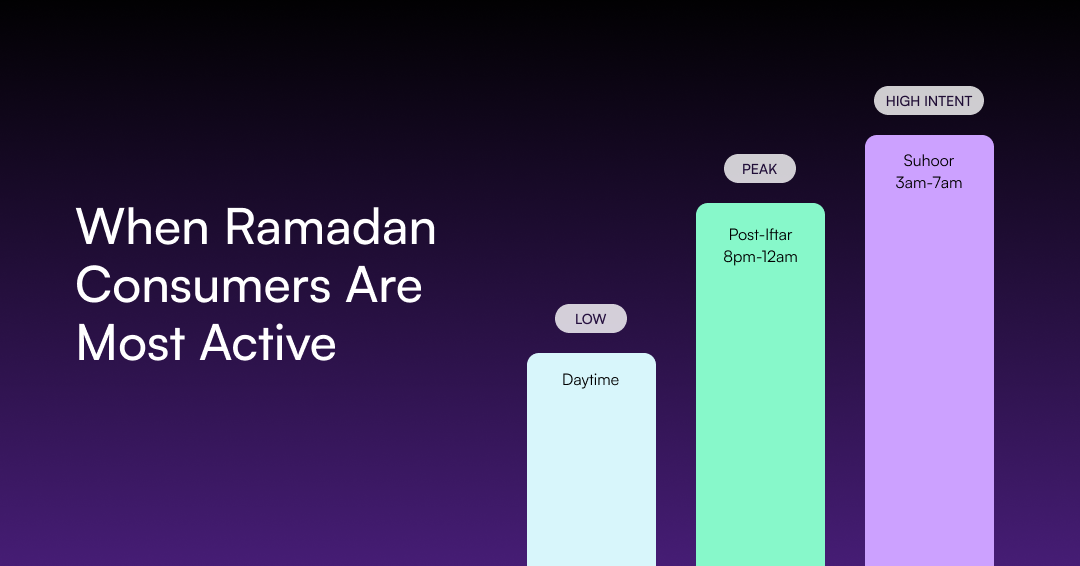
Data from Criteo and Adjust tracking SEA shopping behaviour shows that the largest uplift in sales compared to pre-Ramadan levels occurs during Suhoor, the pre-dawn meal. In Malaysia, this activity peaks between 4am and 7am. In Indonesia, it peaks between 3am and 5am. These are not large overall volumes, but the engagement rate and intent level during these windows is disproportionately high.
For businesses running WhatsApp campaigns during Ramadan, the practical implication is clear: broadcast messages sent in the 8pm to midnight window consistently outperform daytime sends. The audience is awake, relaxed after Iftar, and in a browsing and buying mindset.
Trend 3: Mobile Is the Primary Shopping Channel
Ramadan accelerates mobile commerce adoption in ways that persist beyond the month itself.
Adjust data shows that shopping app installations in Southeast Asia increased 28% during Ramadan compared to the annual average.
Consumers are not just browsing on mobile during Ramadan, they are completing purchases, comparing prices, asking questions, and arranging deliveries. For businesses, this means the customer experience on mobile is not a secondary consideration during this period. It is the primary one.
A customer who is active on their phone at 10pm during Ramadan is almost certainly using a messaging app, not checking email. WhatsApp and social media are where the conversation happens. Brands that are not present and responsive on these channels during Ramadan are not present at all.
Trend 4: Certain Categories Spike Sharply and at Different Times
Not all product categories follow the same pattern during Ramadan. Understanding which categories peak when helps brands time their campaigns more precisely.
Fashion and clothing Apparel searches surge at the start of Ramadan as consumers begin looking for new outfits for Eid. Microsoft Advertising data shows a 131% year-on-year lift in apparel searches in Indonesia during Ramadan. This category needs early campaign activation - consumers who start browsing at the beginning of the month are often making their decisions two to three weeks before Eid.
Food, beverages and groceries Grocery and food spending increases throughout the month as families host Iftar gatherings and prepare for Eid celebrations. FMCG categories including baking ingredients and non-alcoholic beverages see consistent retail growth across Malaysia and Indonesia.
Gifts and occasions Gift-related searches show a 97% year-on-year lift in Vietnam and strong growth across Malaysia and Indonesia. The gifting decision window is concentrated in the final two weeks of Ramadan, when consumers shift from considering to deciding. Delivery options are a critical factor - 96% of Malaysian Ramadan shoppers in one survey identified delivery options including guaranteed Eid delivery as a significant influence on their purchase decision.
Home and decor Home decoration and improvement interest runs throughout Ramadan as consumers prepare their homes for Eid gatherings. This is a category where early-to-mid Ramadan campaigns perform well.
Financial services Finance-related searches remain elevated throughout Ramadan in markets including Singapore and Malaysia. Consumers are managing budgets for gifts, travel, and donations alongside their regular expenses. Financial services brands that communicate clearly and offer helpful guidance during this period build meaningful trust.
Trend 5: Price Matters, but It Is Not the Only Driver
Affordability is consistently ranked as a top priority for Ramadan shoppers across Southeast Asia. TGM research in Malaysia found that 97% of Ramadan shoppers prioritise affordability during the period.
But price sensitivity does not mean consumers only buy from the cheapest option. It means they are more deliberate. They compare, they research, and they look for value - which includes delivery reliability, brand trust, and the quality of the post-purchase experience.
The same TGM research found that 70% of Malaysian consumers expressed openness to exploring new brands during Ramadan. This is a significant finding for brands not currently top-of-mind with Muslim consumers. Ramadan is genuinely one of the best periods in the year to earn a first purchase from a customer who has never bought from you before, if the experience is right.
Ramadan shoppers are not just looking for the lowest price. They are looking for brands they can trust to deliver literally and figuratively before Eid.
Trend 6: Authentic Communication Outperforms Promotional Messaging
Research by YouGov across Southeast Asian markets consistently shows that what consumers consider authentic Ramadan advertising is not the loudest or most promotional. It is the most contextually relevant.
In Malaysia, messaging that acknowledges the spiritual and family dimension of the month without being performative or superficial about it - resonates more strongly than generic discount campaigns. Consumers notice when a brand understands what Ramadan actually means versus when a brand is simply using it as a sales backdrop.
This does not mean brands should avoid commercial messaging during Ramadan. It means commercial messaging should be embedded in genuine usefulness. A WhatsApp campaign that helps a customer find the right gift for their parents, confirms a delivery will arrive before Eid, or answers a product question at 11pm is both commercial and helpful. That combination is what earns trust.
Brands using AI-powered conversational flows during Ramadan are well-positioned here - not because the technology feels festive, but because instant, accurate, helpful responses at any hour are exactly what consumers want and remember.
Trend 7: Responsiveness Is the Real Competitive Advantage
Across all the data on Ramadan consumer behaviour, one pattern is the most commercially important and the most consistently underestimated by brands: consumers are active when most businesses are not.
The peak browsing and buying windows fall after Iftar and during Suhoor. A significant share of customer questions, order enquiries, and purchase decisions happen between 9pm and midnight. Brands with a team actively monitoring and responding during these hours hold a real advantage. Brands that are offline miss the conversation entirely.
Retail sales across Southeast Asia rose 13% year-on-year during Ramadan 2025 according to Criteo data, with Malaysia seeing a 26% increase. This is not a small commercial opportunity. And a meaningful share of that revenue goes to the brands that are simply available and responsive when customers are ready to buy.
An AI Agent configured for Ramadan handling stock questions, delivery timelines, gifting recommendations, and order status at any hour - is one of the most direct ways to capture this opportunity without building a night shift. Learn more about how Agentic AI handles complex, multi-step customer requests automatically.
What This Means for Your Business
Understanding Ramadan consumer behaviour is not an academic exercise. Each of the trends above points to a specific business decision.
- Start your awareness campaign before Ramadan begins, not when it does.
- Save your strongest offers and most active campaigns for the final two weeks.
- Schedule your WhatsApp broadcasts for after Iftar. Be available to respond late at night.
- Prioritise WhatsApp over email. That is where your customers are.
- If you have never run a Ramadan campaign before, this is the right time to start. Consumers are genuinely open to new brands.
- Do not just send discount blasts. Send messages that help your customer - a gift recommendation, a delivery update, a quick answer at 11pm.
For businesses across Southeast Asia, Ramadan is the most important commercial period of the year. The brands that approach it with data and the right tools to act on that data consistently outperform those that rely on guesswork and generic campaigns.
To see how AiChat helps brands manage Ramadan communication and campaigns at scale, book a free consultation.


