

How Conversational AI Recovers Lost Revenue
Executive Summary: Most shoppers abandon their cart because of unanswered questions, checkout friction, or simple distraction. Conversational AI on WhatsApp and web chat solves these issues by responding instantly, recovering abandoned carts automatically, and guiding shoppers back to purchase without requiring additional headcount.
7 out of 10 shoppers who add something to their cart never buy it.
This is not a rounding error. It represents billions of dollars leaving the table every year. For most eCommerce brands in Southeast Asia, this happens silently with no follow up and no understanding of why.
While the Baymard Institute puts the global average cart abandonment rate at 70.19%, data from Statista confirms this alarming trend, showing that in many sectors, the abandonment rate frequently exceeds 75% for mobile users. In mobile-first markets where most shopping happens on a smartphone, that number is even higher. To win in 2026, brands must understand what is causing this and how to fix it.
What is Cart Abandonment and Why Does it Keep Happening?
Cart abandonment occurs when a shopper adds items to their online cart but leaves before completing the purchase. Most brands treat this as a retargeting problem by throwing Facebook ads or discount emails at the customer. However, this approach is losing effectiveness as ad costs rise.
The real cause of abandonment is almost always one of five specific friction points.
- Unanswered Product Questions The shopper wanted to know if the item ships to their city or if it is in stock. No answer appeared so they left.
- Checkout Friction Too many form fields or forced account creation provide a reason to quit.
- Unexpected Costs Shipping fees that only appear at the final step cause shoppers to close the tab.
- Distraction Mobile shoppers browse on the MRT or between meetings. They get pulled away and simply do not come back.
- Decision Uncertainty They wanted to ask a friend or compare prices and no one nudged them back at the right moment.
Why Email and Retargeting Ads Are No Longer Enough
Traditional recovery toolkits were built for a different era. Email open rates for eCommerce are averaging around 20% in 2026. This means four out of five recovery messages go unread. Retargeting ads are increasingly expensive and often ignored by buyers who have learned to tune them out.
Meanwhile, WhatsApp messages in Southeast Asia average open rates above 90%. Messages are read and responses happen. The channel has changed and your recovery strategy must change with it.
How Conversational AI Recovers Lost Revenue
Conversational AI fundamentally changes the equation by providing a systematic response to every abandonment cause.
- Answering Questions Before They Kill the Sale An AI powered chat on your product page or WhatsApp can answer questions about size guides, stock availability, and shipping timelines instantly. When shoppers get instant answers, they do not need to leave to find them elsewhere.
- Handling Decision Uncertainty With Upsell and Social Proof
A shopper sitting on the fence often just needs one more reason to commit. Conversational AI can surface reviews, offer a time-limited incentive, or suggest a related product that adds value at the moment they're most likely to act.
- Triggering Personalised Recovery at the Right Moment
When a shopper goes quiet, AI can automatically send a WhatsApp message. This is not a generic blast. It is a personalised message that references the exact product and offers a single tap return to checkout. This process is most effective when integrated into your wider strategy, such as following up on leads generated through a Click to WhatsApp ads setup. Research shows that recovery messages sent within the first hour have the highest conversion rate.
- The Hybrid Advantage: Agent Support for High Value Carts While an AI Agent handles 90% of routine recoveries, the system can instantly alert a live human agent via Agent CoPilot for high-value orders. This ensures that complex queries or VIP customers receive a white-glove touch when it matters most.
The Numbers Behind AI Powered Recovery
Brands using conversational AI for cart abandonment are reporting significant results.
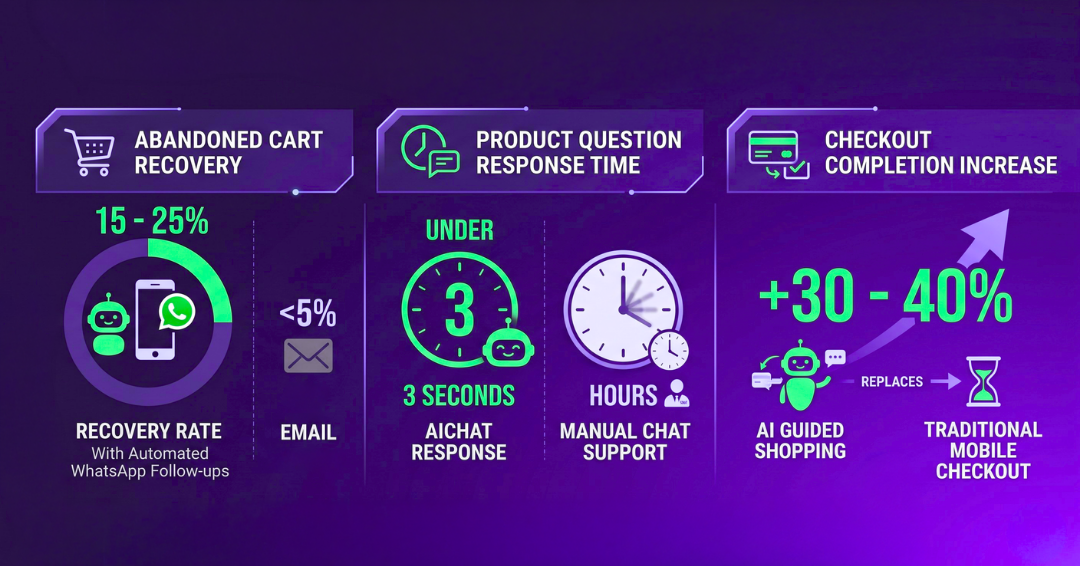
- 15% to 25% recovery rates are achieved on abandoned carts that receive automated WhatsApp follow-ups, according to reports from Chatarmin and SalesCycle. This performance is significantly higher than traditional email recovery campaigns, which see an average click-through rate of only 2% to 5% according to Dotdigital.
- Response times under 3 seconds are standard for AI agents. According to Salesforce, 82% of customers expect an immediate response when they have a question. While AI answers instantly, manual chat support average response times can exceed 23 hours.
- 30% to 40% increase in checkout completion rates occurs when AI guided shopping replaces traditional mobile checkout flows. Gartner predicts that by 2026, 80% of routine customer interactions will be handled by AI, significantly reducing friction in the buying journey.
Every Abandoned Cart is a Conversation That Did Not Happen
Cart abandonment is rarely a sign of lost interest. It is almost always a sign of a customer who was met with silence at a critical decision point. In reality, shoppers often get distracted or forget their cart entirely. Without a timely nudge, they naturally begin searching for alternatives from competitors.
Shoppers leave because no one was there to provide reassurance, clarify a policy, or offer a helpful reminder. In the past, scaling a human team to be available for every visitor was a financial impossibility. Today, conversational AI allows your brand to stay present and responsive in the exact channel where your customers spend their time.
The Future of Commerce is Conversational
Understanding the mechanics of cart recovery is just the first step in mastering the modern buying journey. As technology continues to shift toward instant, 1-to-1 interactions, the most successful brands will be those that prioritize availability and responsiveness.
If you are interested in exploring how these shifts are changing the landscape of retail and eCommerce, we are hosting an in-person event titled Conversational Commerce Unlocked on April 29 in Singapore. It is a gathering for industry leaders to discuss practical ways to stay connected with the modern consumer and recover lost revenue through automation. You are welcome to join us there to see these strategies in action.
Frequently Asked Questions

.svg)
Answer
AiChat is custom-engineered specifically for the complex linguistic and commercial landscapes of Southeast Asia. Unlike Western alternatives, our Natural Language Processing (NLP) natively processes localized shorthand and mixed-language environments, including Singlish, Manglish, and Bahasa, ensuring seamless communication without technical drop-offs. Furthermore, our architecture provides distinct deployment models tailored to both local small businesses and massive regional enterprises.

Answer
For small businesses, AiChat functions as a ready-to-use software platform designed for fast deployment. SMBs can immediately tap into our pre-built infrastructure to activate:
- Native E-Commerce Sync: Instant out-of-the-box connections with Shopify and WooCommerce to sync product catalogs and SKUs.
- Frictionless In-Chat Purchases: Pre-configured flows that allow customers to select products and complete purchases via secure payment links inside WhatsApp or Web Chat.
- Turnkey Marketing Workflows: Ready-made drip campaigns and automated WhatsApp follow-ups to recapture abandoned shopping carts with minimal configuration.
Answer
Yes, our existing e-commerce integrations natively process post-purchase operations for all business sizes. The platform connects directly with storefront databases to automate live order updates, shipping notifications, and parcel tracking requests directly through a user's WhatsApp or messaging thread, instantly lowering the volume of routine manual support tickets.


