

Why Enterprise Retailers are Moving Away from Basic Chatbot Apps in Malaysia

For the past decade, the standard playbook for retail e-commerce in Southeast Asia was clear: build a website, drive traffic, and plug in a basic customer service chat widget to handle repetitive questions. If the bot deflected an angry query or provided an automated refund status, it was deemed a success.
But in 2026, that playbook is no longer winning.
The Malaysian digital market has hit structural maturity. With a staggering 98% internet penetration rate across 35.4 million users, the battleground for consumer loyalty has completely shifted. Modern shoppers are no longer willing to navigate rigid, decision-tree bots that feel like a dead end.
Instead, a profound behavioral shift has occurred. Malaysian enterprise retailers are actively abandoning generic, rules-based chatbot applications in favor of flexible, localized conversational AI platforms. The goal is no longer deflecting customer service tickets, it is driving proactive chat sales at the exact moment of intent.
The Problem with 2016-Era Scripted Bots
Many businesses in Malaysia are still utilizing legacy chatbot apps that rely on pre-programmed scripts. When a customer inputs a query that deviates slightly from the script, the bot fails, resulting in consumer frustration.
These rigid applications create massive friction in the checkout funnel. While they excel at basic ticket deflection, they are fundamentally incapable of reading user context, handling complex product inquiries, or helping a user complete a transaction.
In an era where regional digital interactions require high-speed personalization, relying on an inflexible application behaves more like an automated barrier than an actual customer service assistant.
Meeting Customers Where They Are: The WhatsApp Moat
To understand why basic applications are failing, look no further than the unique messaging habits of the local market.
Malaysia leads global metrics in messaging engagement. According to cloud communications leader Infobip’s global Messaging Trends Report 2026, which evaluated 628 billion mobile channel interactions, the shift toward rich conversational mediums is accelerating drastically across the region.
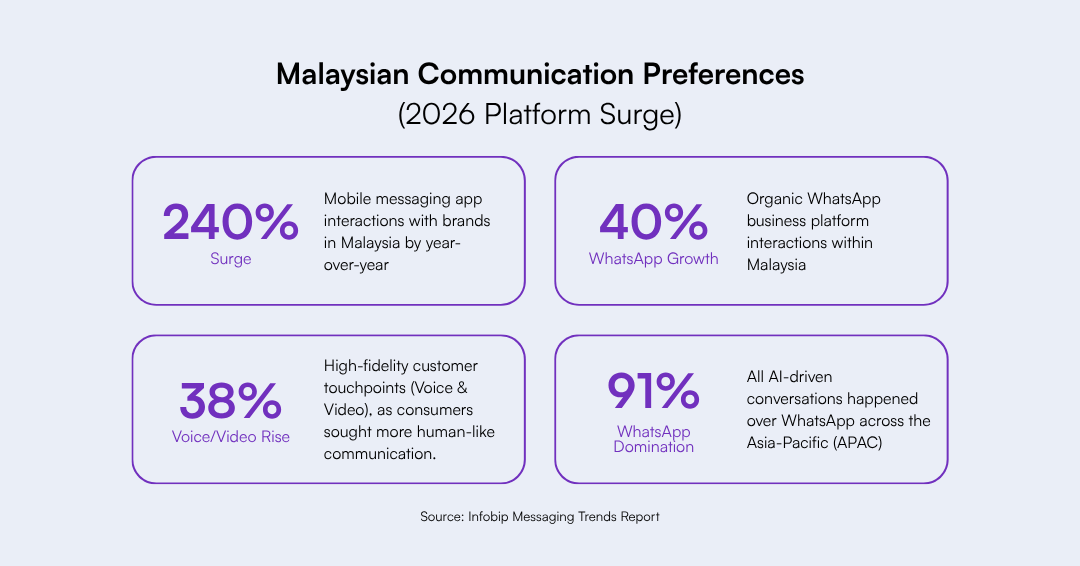
The data reveals that based on the Malaysian market, there has been an astounding 240% surge in mobile messaging app interactions. Furthermore, within the broader conversational landscape, WhatsApp completely dominates, facilitating 91% of all conversational AI interactions on the platform.
Malaysian consumers do not view chat apps merely as tools for text messaging. They view them as primary ecosystems for product discovery, direct communication with brands, and immediate order verification. When an enterprise limits its chat infrastructure to a basic web widget, it completely misses out on the massive volume of traffic flowing through the WhatsApp Business API. Enterprise-grade platforms allow retailers to bring their complete commercial workflows directly into WhatsApp, creating an environment where sales are captured on the app consumers open every hour.
Shifting from Ticket Deflection to In-Chat Conversions
The modern rule of digital commerce is simple: Whoever makes it easier, faster, and more convenient to buy, wins. Enterprise retailers are moving toward highly adaptable platforms because they turn chat into a proactive revenue driver. Rather than treating a customer conversation as an operational expense to be minimized, forward-thinking brands treat it as a direct sales opportunity.
By using an open, modular platform framework, technical teams can connect conversational interfaces directly to existing proprietary backend databases, local payment gateways, and core enterprise customer CRMs like Salesforce or HubSpot.
This enables advanced, revenue-driving capabilities that basic applications simply cannot match:
- SKU-Level Inventory Matching: The AI instantly reads live inventory data to verify stock levels in real time, serving accurate product recommendations dynamically.
- Localized Linguistic Understanding: Advanced platforms process native context, colloquialisms, and regional shorthand, including Singlish, Manglish, and Bahasa, ensuring smooth buyer journeys without communication drops.
- Proactive Cart Recovery: If a customer abandons a purchase, the system can trigger automated WhatsApp follow-up workflows, offering targeted incentives or answering sizing hesitations to recover lost revenue.
The transition is transparent. In 2026, your brand’s responsiveness is no longer just an isolated support metric, it is your complete brand identity. The winners of tomorrow are the retail leaders who stop treating chat as a ticketing queue and start treating it as their most powerful channel for business growth.
Frequently Asked Questions

.svg)
Answer
Basic chatbot applications rely on pre-set, rigid scripts that fail when a user deviates from the program. They are designed exclusively for support deflection, creating friction for modern consumers who expect intuitive, fluid communication during product discovery and purchasing.

Answer
Malaysia has one of the highest messaging app penetration rates globally, with 93% of online citizens using WhatsApp daily. Furthermore, localized data reveals that WhatsApp commands 91% of all conversational AI interactions in the market. This means if your brand isn’t natively present on the WhatsApp Business API, you are missing your target audience where they are most active.
Answer
By upgrading from standard rules-based apps to localized conversational platforms, brands can link chat threads directly with custom enterprise ERPs and storefront inventory. This allows the AI to autonomously handle product recommendations, manage objection handling, and push localized cart-recovery sequences directly within the chat window to maximize conversions.
Answer
Yes. While generic, basic applications struggle outside of standardized languages, advanced conversational AI engines are custom-trained on regional datasets. They smoothly process mixed-language inputs, shorthand, and colloquial variations including Bahasa, Singlish, and Manglish, providing an authentic customer experience.


